How Much Does Korea Cost? Daily Budget by Travel Style
Some links are affiliate links. We may earn a commission at no extra cost to you. How affiliate links work.
Tap a heading to read that section.
Every "how much does Korea cost" figure you'll find online is a different number, because they're built from different assumptions about lodging and whether flights are included. Below are the ranges from several 2026 sources side by side, so you can see where they agree and where they don't — and then a category breakdown using prices already verified elsewhere on this site.
Important: none of the day-rate figures below are prices Land in Korea checked directly — they're ranges reported by third-party travel-cost sites, gathered 2026-10-31. Treat them as a planning range, not a quote. The category breakdown that follows uses prices we do track directly, with their own confirmation dates.
Daily cost by travel style (third-party estimates, per person, excluding flights)
| Style | Daily range (USD) | What's included |
|---|---|---|
| Backpacker | $40-90 | Dorm bed, street food/market meals, subway or bus |
| Mid-range | $100-225 | Private hotel room, sit-down meals, most attractions |
| Comfort | $225+ | Upscale hotel, restaurant dining, taxis over transit |
Sources disagree most at the low end: Wego and Hello Travel put backpacker days at $40-70, while Seoul Tourism Organization's own figure runs ₩80,000-120,000 (roughly $60-90). The gap is mostly hostel pricing — Seoul dorm beds run from about ₩15,000 up to ₩25,000 a night depending on neighborhood and season, and which end of that range a source assumes changes their whole daily total.
Mid-range estimates cluster more tightly: $100-160 from most sources, with Seoul Tourism Organization's upper estimate ($135-225) reflecting a nicer hotel room specifically. See our neighborhood-by-neighborhood Seoul hotel price comparison for how much of that range is just which part of the city you book in.
Where your money actually goes, by category
Transit: A Seoul subway ride costs 1,550 won and a blue or green city bus 1,500 won on a T-money card (adult base fares for the first 10 km), with transfers between bus and subway free within the transfer window. One source puts average daily transport spend around $10. Four base-fare subway rides come to only ₩6,200, or roughly $4.50, so that $10 leaves room for longer rides or the occasional taxi.
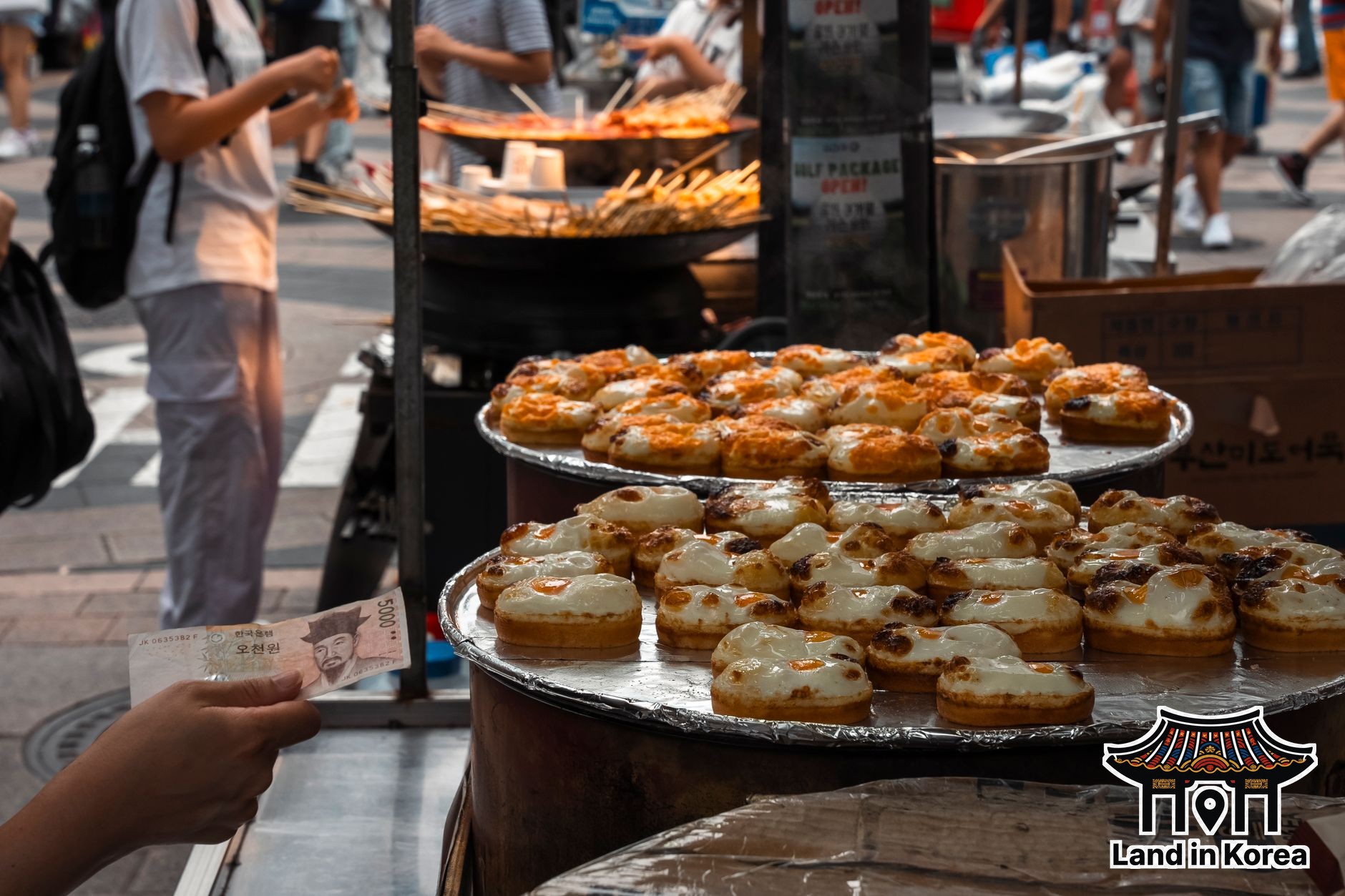
Food: This is where travel style changes your total the most. Convenience-store meals and market food (see our traditional markets and street food guide) are genuinely cheap: at Gwangjang Market, bindaetteok runs about ₩5,000-6,000 a plate and mayak gimbap about ₩3,000-4,000 per tray (confirmed 2026-11-01). For planning, count around ₩20,000 for a sit-down restaurant meal. Backpackers eating mostly market and convenience-store food can keep a full day's meals under $15; mid-range travelers eating 2-3 restaurant meals a day should expect $30-50.
Lodging: The single biggest swing factor in every source we checked. Budget for ₩15,000-25,000/night for a single bed in a hostel dorm (private hostel rooms cost more), ₩100,000-200,000/night for a mid-range private hotel room, scaling up sharply from there for upscale properties. See the full neighborhood breakdown in our hotel comparison guide.
Connectivity: Covered in detail in our eSIM and mobile data guide — budget roughly $8-12 for a 1GB, 7-day eSIM plan or $12-18 for 2GB over 10 days.
Attractions: Palace entry is cheap: Gyeongbokgung costs 3,000 won for an adult (confirmed 2026-11-01), and wearing a complete hanbok that meets the palace's guidelines gets you in free. The bigger attraction cost is usually a single splurge item: a theme park day (Everland or Lotte World) or a DMZ tour, which alone can run $35-200+ depending on tier.
One lever worth knowing about: if your trip includes several paid attractions, bundling them through a marketplace like Klook — which sells individual Seoul attraction tickets, combo passes, and tours together — can work out cheaper than buying each ticket separately, and it consolidates your attraction budget into a short list instead of cash or cards at a dozen different ticket windows. Worth comparing against walk-up prices for whatever's actually on your list before you commit to a bundle.
A rough day, three ways
Backpacker day: Hostel dorm (~₩20,000) + market/convenience-store meals (~₩15,000) + subway rides (~₩5,000) + no paid attraction that day ≈ ₩40,000, or roughly $30.
Mid-range day: Private hotel room (~₩150,000, split two ways if traveling as a pair = ~₩75,000 each) + two restaurant meals (~₩40,000) + subway (~₩5,000) + one paid attraction (~₩10,000) ≈ ₩130,000, or roughly $95.
Comfort day: Upscale hotel (~₩300,000+) + restaurant dining (~₩80,000+) + taxis instead of transit (~₩30,000+) + attractions/activities (~₩50,000+) ≈ ₩460,000+, or roughly $340+.
These are illustrative, not quotes, and they come in under the third-party ranges above because they assume a day with little or no paid sightseeing and, for mid-range, a shared room — your actual day will move with season, how many cities you cover, and how often you eat out versus cook or grab convenience-store food.
How season changes these numbers
None of the ranges above account for seasonal swings, which are real in Korea. Cherry blossom season (late March-early April) and peak fall foliage (late October-early November) push hotel rates up across every travel style, sometimes substantially in popular neighborhoods — see our cherry blossom and fall foliage timing guide for exact windows. Korean public holidays, especially Seollal and Chuseok, also spike domestic travel demand and prices as locals travel too, not just visitors. If your dates are flexible, shifting even a few days off a peak window can meaningfully change your lodging line item, which — per the section above — is the single biggest swing factor in your whole daily budget anyway.
Official sources
Category prices specific to this site (T-money fares, eSIM/data pricing) are checked against our own guides, dated as noted above, and against Korea Tourism Organization. The cross-source daily-budget ranges are drawn from third-party 2026 travel-cost guides, accessed 2026-10-31: Wego, Mileasia, Seoul Tourism Organization, Hostelz, ZenKimchi, and Travel with Hello. These sources don't agree exactly with each other — we've flagged where they diverge rather than picking one as authoritative.
Frequently Asked Questions
Is Korea cheaper or more expensive than Japan for travelers?
Most comparison sources put Korea slightly cheaper than Japan at the backpacker and mid-range level, mainly on food and transit, with lodging roughly comparable. We haven't independently verified a side-by-side comparison, so treat this as a general reputation rather than a confirmed figure.
What's the single biggest way to cut daily costs?
Lodging, by a wide margin. The gap between a hostel dorm bed and a private mid-range room is often larger than your entire food and transit budget combined for the day.
Do these estimates include flights to Korea?
No. Every daily-rate figure above excludes international flights, which vary too much by origin city and season to fold into a daily rate. Budget flights separately.
Should I bring cash or rely on cards?
Both. Markets and smaller food stalls often take cash only (see our markets guide), while hotels, chain restaurants and transit cards work fine with cards or mobile pay. Carry some cash, but you won't need large amounts at once.